
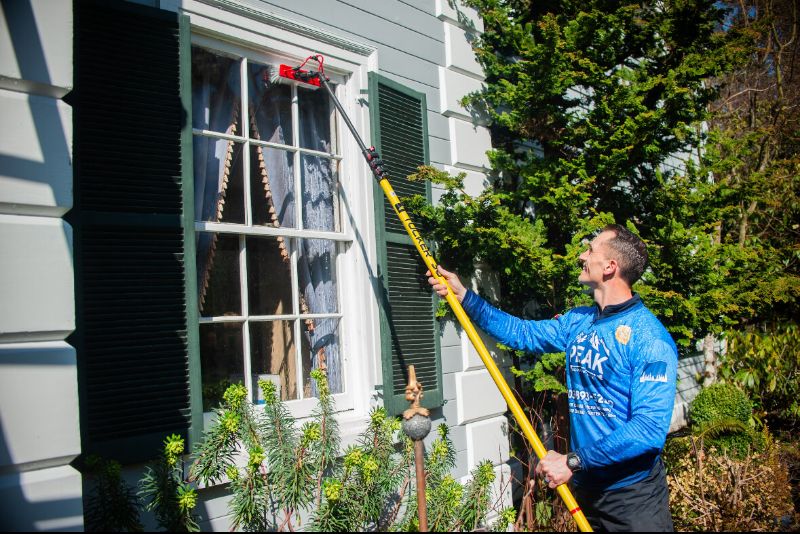
Your north-facing wall gets dirtier because it receives little to no direct sunlight, eliminating UV rays that kill bacteria and accelerate moisture evaporation. Without consistent sun exposure, surfaces stay damp longer, creating ideal conditions for algae, mold, and lichen to colonize. Airborne particulates bond to these wet surfaces, compounding the buildup. Climate factors like humidity, coastal salt aerosols, and freeze-thaw cycles further accelerate fouling—and understanding each mechanism helps you address the problem more effectively.
Key Takeaways
-
North-facing walls receive minimal direct sunlight, preventing UV rays from killing bacteria and inhibiting biological growth like algae and mold.
-
Without consistent sunlight, moisture evaporates slowly, keeping surfaces persistently damp and creating ideal conditions for dirt accumulation.
-
Wind patterns drive rain and airborne debris against north-facing walls, where wet surfaces bond particulates more effectively.
-
Shade maintains higher moisture levels year-round, allowing algae, moss, and lichen to colonize surfaces rapidly and continuously.
-
Biological growth like algae forms dark biofilms that attract additional dirt, compounding accumulation faster than on sunlit walls.
Why North-Facing Walls Attract More Dirt Than Any Other Side
If you’ve ever noticed that the north-facing wall of a building looks grimier than its counterparts, there’s a definitive physical reason behind it.
North-facing walls receive minimal direct sunlight in the Northern Hemisphere, creating consistently cooler, moisture-retaining surfaces. This persistent dampness accelerates biological growth — algae, mold, and lichen — while simultaneously attracting airborne particulates that bond to wet surfaces.
The result is accelerated dirt accumulation compared to sun-exposed walls. Wind patterns compound the problem further, as prevailing winds frequently drive rain and debris against north-facing surfaces at oblique angles.
Without UV exposure to dry and sterilize the surface, grime embeds deeper into the material. Consequently, wall maintenance on the north side demands greater frequency and more aggressive cleaning protocols than any other elevation.
Does Climate Change How Fast Your North Wall Gets Dirty?
Whether you live in a humid subtropical region or a semi-arid highland, your local climate directly controls the rate at which your north-facing wall accumulates biological and particulate fouling.
Climate impact varies greatly across regions, accelerating or decelerating microbial colonization and dirt adhesion based on moisture availability, temperature cycling, and prevailing weather patterns.
In high-humidity environments, you’ll see algae and mold establish colonies within weeks.
In arid climates, dust and fine particulates dominate instead, bonding to surface pores during infrequent rainfall events.
Freeze-thaw cycles in colder zones compromise surface coatings, creating microtextured substrates that trap contaminants more efficiently.
Coastal weather patterns introduce salt aerosols, compounding biological and chemical fouling simultaneously.
Your specific climate zone consequently determines both the fouling mechanism and its progression rate.
Why Sunlight Is Your Wall’s Best Defense Against Grime
When sunlight strikes your south-facing walls, UV rays actively kill surface bacteria that would otherwise break down your wall’s finish and trap airborne grime.
The radiant heat accelerates moisture evaporation, preventing the damp conditions that allow algae, mold, and dirt to adhere and accumulate.
Your north-facing walls, however, receive little to none of this natural cleaning mechanism, leaving them perpetually vulnerable to biological and particulate buildup.
Sunlight Kills Surface Bacteria
Sunlight does more than illuminate your walls—it actively destroys the bacteria and microorganisms that accelerate grime buildup. UV radiation disrupts bacterial DNA, halting bacterial growth before colonies establish. North-facing walls, lacking consistent sunlight exposure, miss this natural sanitizing process entirely.
Here’s what sunlight’s UV radiation does to surface microorganisms:
-
Denatures proteins within bacterial cell structures, causing cellular collapse.
-
Fragments DNA strands, preventing bacterial reproduction cycles.
-
Oxidizes lipid membranes, destroying the cell’s protective outer layer.
-
Neutralizes fungal spores before they anchor into wall surfaces.
Without these UV-driven reactions, your north-facing walls become breeding grounds for microbial colonies.
These colonies trap airborne particles, accelerating visible discoloration. Understanding this mechanism explains why strategic cleaning schedules and antimicrobial treatments specifically target shaded wall surfaces.
UV Rays Prevent Moisture
UV rays don’t just kill bacteria—they actively drive moisture evaporation from wall surfaces, preventing the damp conditions that accelerate grime accumulation.
When sunlight consistently strikes your walls, it reduces moisture retention by rapidly cycling surface humidity away before biological growth establishes itself.
North-facing walls receive minimal direct radiation, leaving them perpetually susceptible to dampness that bonds airborne particles and organic debris into stubborn layers.
You’ll notice south-facing walls dry faster after rain precisely because UV exposure accelerates evaporative processes.
This thermal-photonic effect is critical to effective wall maintenance—without it, your surfaces become ideal environments for mold, algae, and particulate adhesion.
Understanding this mechanism explains why strategic cleaning schedules must compensate for what natural sunlight can’t provide on shaded wall sections.
Heat Dries Dirt Faster
Beyond moisture control, heat itself operates as a separate and equally significant factor in grime resistance. Sun-exposed walls retain thermal energy that actively combats dirt accumulation through four distinct mechanisms:
-
Accelerates surface evaporation, preventing particle adhesion
-
Reduces atmospheric humidity directly against the wall surface
-
Destabilizes organic contaminants, breaking their structural bonds
-
Creates convective airflow patterns that physically dislodge loose particles
Your north-facing wall’s chronic grime problem stems directly from its inability to harness heat retention. Without consistent solar thermal input, dirt particles bond more permanently to surface materials.
South-facing walls inherently self-clean through repeated heating cycles throughout the day. You’re fundamentally watching your north wall accumulate compounding layers of grime that thermally active surfaces naturally shed without any intervention.
How Shade Creates the Perfect Environment for Algae and Moss
Shade fundamentally alters the microclimate of a north-facing wall by reducing evaporation rates and maintaining consistently higher moisture levels on the surface.
These shade benefits create an environment where algae and moss don’t just survive — they thrive. You’ll notice that moisture retention on shaded surfaces remains elevated throughout the day, even during warmer months, because direct sunlight never reaches these walls long enough to dry them out.
Algae spores, which are constantly present in the atmosphere, land on your wall and immediately exploit this persistent dampness. Moss follows the same pattern, anchoring itself into porous surfaces like brick and mortar.
Without UV radiation and thermal drying to counteract biological colonization, these organisms establish themselves rapidly and accelerate the visible deterioration of your north-facing wall’s surface.
Why North-Facing Walls Stay Damp Longer
Because north-facing walls receive little to no direct sunlight, they can’t generate the surface heat needed to drive evaporation effectively. This moisture retention creates persistently damp conditions that accelerate biological and chemical deterioration.
Temperature variations between seasons further compound this problem, preventing walls from drying consistently.
Four key factors explain prolonged dampness:
-
Absent solar radiation eliminates the primary evaporation mechanism
-
Reduced airflow in shaded zones slows surface drying considerably
-
Temperature variations cause condensation cycles that reintroduce moisture overnight
-
Porous masonry materials absorb and hold water longer without heat assistance
You’re fundamentally dealing with a surface that stays wet far longer than sun-exposed walls.
This extended dampness doesn’t just encourage moss growth—it structurally weakens your wall’s surface materials over time.
Algae, Moss, and Lichen: What’s Actually Growing on Your North Wall
The persistent dampness on north-facing walls creates ideal conditions for three distinct organisms—algae, moss, and lichen—each colonizing your wall through different mechanisms and causing different types of damage.
Algae growth begins first, forming thin green or black biofilms that penetrate porous masonry and accelerate surface degradation.
Moss follows, establishing root-like rhizoids that mechanically fracture mortar joints and trap additional moisture against the substrate.
Lichen, a fungal-algal symbiosis, secretes acids that chemically dissolve stone and brick surfaces over extended periods.
You’ll find these organisms appearing in sequence rather than simultaneously.
Effective moss prevention requires addressing the underlying moisture retention rather than simply removing visible growth, since surface removal without correcting drainage and shade conditions guarantees rapid recolonization within one to two growing seasons.
What Happens to Your Wall If You Ignore the Buildup
If you leave the biological buildup on your north-facing wall untreated, the retained moisture accelerates paint failure, causing blistering and peeling that exposes the substrate beneath.
Once that barrier breaks down, mold penetrates the underlying material, compromising interior air quality and weakening the wall’s composition at a structural level.
You’re then facing not just a cosmetic repair but a progressive deterioration that grows more costly and technically complex the longer you wait.
Paint Begins Peeling
Peeling paint is one of the most visible signs that moisture has been silently compromising your north-facing wall’s structural integrity. Prolonged dampness accelerates paint deterioration through four distinct mechanisms:
-
Moisture penetrates the paint film, breaking its adhesive bond with the substrate.
-
Freeze-thaw cycles expand trapped water, physically forcing paint layers apart.
-
Biological growth beneath the surface pushes paint outward from underneath.
-
UV deprivation weakens the paint’s polymer structure, reducing flexibility.
Once peeling begins, you’re no longer dealing with a cosmetic issue. Exposed substrate absorbs moisture directly, accelerating deeper structural damage.
Consistent wall maintenance stops this cascade before it starts. You should inspect your north-facing wall seasonally, addressing moisture infiltration immediately rather than waiting until complete paint failure forces a costly full-surface restoration.
Mold Spreads Deeper
Exposed substrate left unprotected after paint failure doesn’t just absorb moisture—it becomes a direct pathway for mold colonization into your wall’s deeper layers.
Without intervention, mold types like Cladosporium and Stachybotrys penetrate drywall paper, wood studs, and insulation simultaneously.
You’re no longer dealing with a surface problem—you’re managing structural biological contamination.
These organisms digest cellulose-based materials, weakening your wall’s integrity from inside out.
Effective mold prevention requires you to act before colonization reaches framing members, because remediation costs multiply considerably once structural components are compromised.
Treating only the visible surface while ignoring subsurface moisture pathways guarantees recurrence.
Your north-facing wall’s persistent shade and trapped humidity create ideal anaerobic pockets where deep mold colonies establish themselves well before visible symptoms appear.
Structural Damage Worsens
Once mold colonies penetrate framing members and insulation, the structural degradation accelerates faster than most homeowners anticipate. Prolonged moisture retention compromises your wall’s structural integrity through four distinct failure stages:
-
Wood rot weakens load-bearing studs, reducing their compressive strength markedly.
-
Insulation saturates completely, eliminating thermal resistance and inviting additional condensation cycles.
-
Fasteners and metal connectors corrode, loosening critical structural connections throughout the assembly.
-
Drywall substrate delaminates, causing surface instability that signals deeper systemic failure.
You’re no longer dealing with cosmetic issues at this stage—you’re facing potential structural compromise requiring professional remediation.
Early intervention costs considerably less than full wall reconstruction. Ignoring north-facing wall buildup transforms a manageable cleaning task into an expensive, time-consuming structural repair project demanding immediate expert assessment.
How to Slow Down and Clean North-Facing Wall Grime
Combating grime on north-facing walls requires a two-pronged strategy: slowing its accumulation and removing what’s already built up.
Start with prevention-focused maintenance tips: apply a water-repellent sealant to exterior surfaces, which reduces moisture retention and limits biological growth. Confirm gutters and downspouts direct water away from the wall’s base.
For active cleaning techniques, use a diluted bleach solution (1 part bleach to 10 parts water) to neutralize mold, algae, and moss. Apply it with a stiff-bristled brush, scrubbing in circular motions, then rinse thoroughly.
For interior walls, a commercial mold-inhibiting cleaner works effectively. Reapply exterior sealant every two to three years to maintain its protective barrier.
Consistent upkeep prevents minor grime from escalating into the structural damage discussed previously.
Frequently Asked Questions
Can North-Facing Wall Grime Affect My Home’s Resale Value?
Yes, north-facing wall grime can hurt your resale market value. You’ll want to prioritize wall maintenance, as buyers and inspectors actively flag visible dirt accumulation, potentially reducing your property’s perceived condition and negotiated sale price.
Are Certain Wall Colors More Resistant to Dirt on North-Facing Walls?
Yes, your color selection matters greatly. Darker, mid-tone hues conceal grime better on north-facing walls. You’ll find maintenance tips recommend avoiding stark whites, as they’ll highlight dirt accumulation faster, demanding more frequent cleaning interventions.
Does Wall Texture Influence How Quickly North-Facing Walls Accumulate Grime?
Yes, texture types greatly impact grime accumulation. Rough surfaces trap more particles, accelerating dirt buildup on your north-facing walls. You’ll find smoother finishes require less frequent cleaning methods, making maintenance notably easier and more efficient overall.
Can Indoor Humidity Levels Worsen Dirt Buildup on North-Facing Exterior Walls?
Yes, indoor humidity impact accelerates dirt buildup on north-facing walls by promoting condensation and microbial growth. You’ll need stronger cleaning solutions to combat the compounded grime that moisture-laden air deposits on these persistently cooler surfaces.
Are North-Facing Walls in Urban Areas Dirtier Than Those in Rural Settings?
Yes, you’ll find urban pollution greatly accelerates dirt accumulation on north-facing walls compared to rural settings. Environmental factors like vehicle emissions, industrial particulates, and higher moisture retention combine, making urban north-facing walls considerably dirtier than their rural counterparts.
Break the Cycle on Your North-Facing Walls
North-facing walls don’t get the benefit of direct sunlight, which means moisture lingers, algae takes hold, and grime bonds more easily to the surface. Over time, this creates a compounding cycle where dampness fuels growth, and that growth traps even more dirt and moisture. If left untreated, it can lead to staining, material breakdown, and a shorter lifespan for your siding or exterior finish.
The key is to intervene early and consistently. Regular cleaning, improving drainage, and trimming back shade where possible can help disrupt the cycle before it worsens. If buildup is already established, professional soft washing can safely remove it without damaging the surface. Peak Pressure Washing provides exterior cleaning tailored to moisture-prone areas, helping you protect your home and keep it looking clean and well-maintained year-round. Request a free quote today and stay ahead of the problem.