
Milwaukie’s wet climate keeps your concrete driveway constantly saturated, which forces its pores open and lets contaminants like oils, organics, and biological matter penetrate deeper than they would in drier conditions. Rain carries sediment and tannins directly into those open pores, while persistent moisture accelerates algae and moss growth that actively degrades the surface. Understanding each factor behind this process will help you protect your driveway before the damage compounds.
Key Takeaways
-
Milwaukie’s wet climate saturates concrete pores, allowing contaminants like oils, sediment, and organic debris carried by rain to penetrate deeply.
-
Damp conditions promote algae, moss, and mold growth, which produce organic acids that actively degrade and discolor concrete surfaces.
-
Tannins from surrounding vegetation create stubborn brown and black stains that become increasingly difficult to remove over time.
-
Concrete’s porous nature traps moisture, causing dirt particles to bond with the surface as water evaporates, accelerating deterioration.
-
Freeze-thaw cycles worsen absorption issues by expanding trapped moisture, further opening concrete pores to deeper contamination and staining.
Why Wet Weather Makes Concrete Stain Faster
Milwaukie’s wet climate creates near-perfect conditions for concrete staining, and understanding why helps you stay ahead of the damage. Moisture accumulation keeps concrete surfaces saturated for extended periods, opening the pores and allowing contaminants to penetrate deeply rather than sitting on the surface.
Rain carries organic debris, oils, and sediment directly into those open pores, embedding stains before you even notice them forming.
Environmental factors compound the problem considerably. Algae, moss, and mold thrive in consistently damp conditions, and once they establish themselves in concrete’s porous structure, they’re difficult to remove without professional intervention. Regular maintenance prevents costly repairs from water damage and staining issues that can arise in wet climates.
Tannins from surrounding trees and vegetation wash across your driveway with every rainfall, leaving behind stubborn brown and black discoloration. The result is accelerated staining that dry-climate concrete simply doesn’t experience at the same rate.
The Role Moss and Algae Play in Driveway Discoloration
Of the biological contaminants that accelerate concrete deterioration in wet climates, moss and algae are the most damaging and the most commonly misunderstood.
Algae buildup typically appears first, establishing thin biofilm layers that penetrate concrete’s porous surface and retain moisture continuously. That sustained moisture creates the ideal environment for moss growth, which follows with root-like structures called rhizoids that physically expand micro-cracks within the slab.
Both organisms produce organic acids that chemically react with concrete, breaking down the calcium carbonate matrix and causing progressive discoloration. What you’re seeing on your driveway isn’t surface-level staining you can simply rinse away. It’s active biological degradation.
Milwaukie’s persistent rainfall accelerates this cycle, meaning untreated concrete doesn’t just look worse over time—it structurally weakens faster than in drier climates. In fact, the conditions for algae growth are exacerbated by the region’s high humidity, leading to quicker deterioration.
Common Stain Types on Milwaukie Concrete Driveways
Concrete driveways in Milwaukie accumulate several distinct stain types, and identifying each one correctly determines how it should be treated.
Oil stains penetrate deeply into porous concrete, leaving dark, greasy patches that resist standard rinsing.
Rust marks typically originate from metal furniture, tools, or corroded rebar near the surface, producing reddish-brown discoloration that bonds tightly to the concrete matrix.
Tire tracks deposit rubber compounds and petroleum residues that darken over time, especially when wet conditions accelerate absorption.
Dirt buildup compounds these issues by trapping moisture against the surface, creating layered staining that becomes increasingly difficult to remove.
Each stain type requires a specific treatment approach, and applying the wrong method can set stains deeper rather than extracting them effectively. Regular cleaning enhances aesthetic appeal and helps prevent these stains from becoming entrenched.
How Porous Concrete Traps Moisture and Dirt
Because concrete is inherently porous, it draws moisture and contaminants inward through a network of microscopic capillaries running throughout its structure.
Like other porous materials, concrete doesn’t simply get wet on the surface — it absorbs and retains substances deep within its matrix. In Milwaukie’s wet climate, that moisture retention creates compounding problems.
Here’s what happens inside your driveway:
-
Rainwater carries dissolved organics, oils, and minerals directly into the concrete.
-
Trapped moisture creates an ideal environment for moss, algae, and mold colonization.
-
Freeze-thaw cycles expand absorbed water, widening capillaries and increasing future absorption.
-
Dirt particles settle into open pores, bonding with the surface as moisture evaporates.
Each wet season accelerates this cycle, making your driveway increasingly vulnerable to deep-set staining and structural degradation. Regular concrete cleaning is essential to mitigate these issues and extend the lifespan of your driveway.
Can You Remove Deep Stains From Concrete Driveways?
Deep stains in concrete driveways—oil, rust, and algae among the most common—require targeted removal methods that match the stain type and penetration depth.
You can treat surface-level stains with chemical degreasers, poultices, or acidic cleaners, but stains that have saturated porous concrete over time often resist DIY efforts.
When buildup has worked deep into the substrate, professional pressure washing with commercial-grade equipment and cleaning agents consistently produces results that consumer-level tools can’t match. Additionally, professional concrete washing can significantly enhance the appearance and longevity of your driveway.
Deep Stain Removal Methods
Whether a deep stain is removable depends on the stain type, how long it’s been set, and how porous your concrete is.
Stain prevention is always more cost-effective, but several cleaning techniques can address deep penetration:
-
Oil and grease: Apply a degreaser or poultice, let it dwell, then pressure wash at high PSI.
-
Rust stains: Use oxalic or phosphoric acid-based cleaners to break down iron oxidation.
-
Moss and algae: Treat with sodium hypochlorite solution before mechanical removal.
-
Tire marks: Scrub with alkaline degreasers combined with hot water pressure washing.
Older stains that have cured into unsealed concrete are markedly harder to lift.
Professional-grade equipment and chemical treatments improve results considerably compared to standard consumer-grade cleaning methods.
When Professional Help Works
Some stains respond to DIY methods, but once contamination has penetrated deep into the concrete matrix or bonded chemically with the substrate, professional intervention becomes the more practical path.
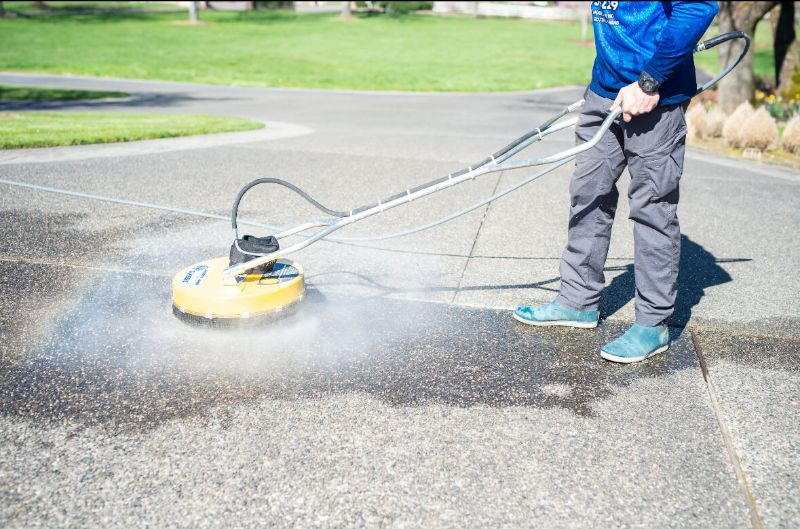
Professionals use commercial-grade hot water extraction, alkaline degreasers, and rotary surface cleaners that generate consistent pressure across the entire slab—equipment that standard consumer units can’t replicate.
For Milwaukie driveways exposed to persistent moisture, professional cleaning also addresses underlying biological growth contributing to stain development.
Beyond removal, technicians can apply penetrating sealers immediately after cleaning, integrating stain prevention directly into the service.
You’ll avoid the cycle of repeated failed treatments, surface abrasion from improper technique, and wasted product costs.
When contamination is deep and widespread, professional cleaning delivers measurable results that protect your driveway’s structural integrity long-term.
Sealing Your Driveway Stops Stains Before They Start
Sealing your concrete driveway is one of the most effective preventive measures you can take against staining, moisture intrusion, and surface degradation. A quality sealant creates a protective barrier that blocks contaminants before they penetrate the concrete matrix.
For Milwaukie homeowners, consistent driveway maintenance with sealing delivers measurable sealant benefits across multiple fronts:
-
Moisture resistance – prevents water absorption that accelerates freeze-thaw cracking
-
Stain repulsion – stops oil, algae, and organic debris from bonding to the surface
-
UV protection – reduces surface oxidation and color fading
-
Easier cleaning – contaminants sit on top rather than embedding deep
Reapply sealant every two to three years to maintain effectiveness. Skipping this step leaves your concrete vulnerable to the exact conditions Milwaukie’s wet climate consistently delivers. Additionally, regular maintenance is necessary to avoid costly repairs, ensuring your driveway remains in optimal condition.
Frequently Asked Questions
How Often Should Milwaukie Homeowners Professionally Clean Their Concrete Driveways?
You should schedule professional driveway maintenance every one to two years. Given Milwaukie’s wet climate, increasing your cleaning frequency annually prevents moss, algae, and stain buildup from permanently deteriorating your concrete surface.
Does Pressure Washing Damage Older or Already Cracked Concrete Driveways?
It can if you’re not careful. Aggressive pressure washing techniques on cracked or aging concrete surface maintenance requires lower PSI settings and wider spray angles to prevent further deterioration, spalling, or forcing water beneath compromised slabs.
Are Eco-Friendly Cleaning Solutions Effective on Heavily Stained Milwaukie Driveways?
Yes, eco-friendly alternatives effectively tackle stain removal on heavily stained Milwaukie driveways. You’ll get powerful results using biodegradable surfactants combined with professional-grade pressure washing equipment, breaking down embedded oil, moss, and algae without harsh chemical damage.
What Is the Average Cost of Professional Concrete Driveway Cleaning in Milwaukie?
You’ll typically pay $150–$300 for professional concrete driveway cleaning in Milwaukie, depending on size and stain severity. Adjusting your cleaning frequency and driveway maintenance schedule can help you minimize long-term costs effectively.
How Long Does Driveway Sealant Typically Last in Portland’s Rainy Climate?
In Portland’s rainy climate, your driveway sealant typically lasts 2–3 years before reapplication’s needed. Consistent driveway maintenance and timely sealant application protect your concrete from moisture intrusion, UV degradation, and accelerated surface breakdown.
Conclusion
Your Milwaukie driveway’s staining problem isn’t cosmetic — it’s structural. Wet climate conditions drive moisture, organics, and minerals deep into porous concrete, accelerating discoloration and surface degradation simultaneously. Once you understand the mechanisms behind staining, you can take a targeted approach: pressure washing to remove existing contamination, treating biological growth at its source, and applying a penetrating sealer to block future moisture infiltration. Don’t wait for stains to compound — act before your concrete’s integrity is compromised.