
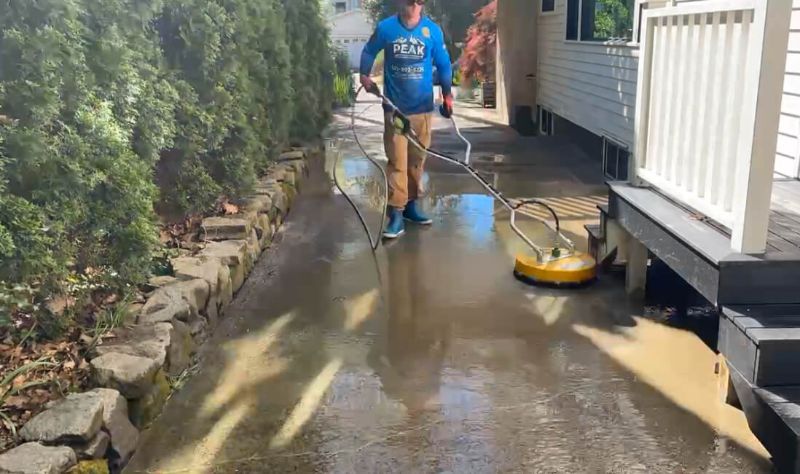
Your driveway turns green every spring because Chlorophyta and Cyanobacteria colonies that established themselves in your concrete’s micro-pores during Portland’s wet winter are now reproducing rapidly in the mild spring temperatures. Portland’s 36-plus inches of annual rainfall and persistent humidity above 80% create ideal germination conditions for these organisms. Shaded surfaces and overhanging canopies accelerate biofilm formation by reducing evaporation. Understanding what’s actually happening beneath that green film will change how you treat it.
Key Takeaways
-
Portland’s wet winters and mild springs create ideal germination conditions for algae, moss, and lichen on driveway surfaces.
-
Average annual rainfall exceeding 36 inches keeps concrete persistently moist, allowing biological colonies to establish and grow rapidly.
-
Overhanging tree canopies reduce evaporation and limit sunlight, favoring shade-tolerant algal species that thrive in damp conditions.
-
Algae forms as a biofilm first, while moss uses rhizoids to anchor into surface micro-cracks, accelerating spring visible growth.
-
Humidity levels frequently above 80% prevent driveways from fully drying, making seasonal biological regrowth nearly inevitable each spring.
What’s Actually Making Your Driveway Turn Green
That green film creeping across your driveway each spring isn’t random discoloration — it’s a biological colonization driven primarily by algae, moss, and lichen.
Chlorophyta and Cyanobacteria are the most prevalent algae types responsible for that thin, slick green layer. They photosynthesize using moisture and ambient light, thriving on porous concrete and asphalt surfaces that retain winter rainfall.
Moss follows where algae establishes, anchoring into surface micro-cracks with root-like rhizoids.
Lichen — a symbiotic algae-fungi organism — bonds even deeper, etching into surface minerals over time.
Portland’s wet winters and mild springs create ideal germination conditions. Moss thrives in moist, shaded environments, making it particularly challenging to control during these seasons.
Standard cleaning products won’t eliminate these organisms at the root level. You need targeted treatments that address biological growth, not just surface appearance.
Why Portland’s Climate Makes Algae Growth Worse
Portland’s climate creates near-ideal conditions for algae proliferation, with annual rainfall averaging over 36 inches and relative humidity frequently exceeding 80% during fall and winter months.
Your driveway accumulates moisture across consecutive wet seasons, allowing chlorophyll-producing organisms like Klebsormidium and Trentepohlia to establish persistent colonies within concrete pores and surface irregularities.
Compounding this, Portland’s tree canopy and overcast skies reduce photosynthetically active radiation at ground level, paradoxically favoring shade-tolerant algal species that outcompete surface desiccation. Regular cleaning of surfaces can help mitigate this algal growth by disrupting the conditions that allow it to thrive.
Portland’s Wet Climate Problem
Everything about Portland’s climate seems engineered to cultivate algae. Annual rainfall averaging 43 inches, combined with mild temperatures rarely dropping below freezing, creates a near-perfect photosynthetic environment.
Chlorophyta (green algae) and cyanobacteria colonize concrete surfaces when moisture retention exceeds 70% humidity for extended periods — a condition Portland satisfies roughly eight months annually.
Your driveway’s porous concrete matrix absorbs and holds moisture long after rain stops. Overhanging tree canopy reduces evaporation further, extending surface hydration and accelerating biofilm establishment.
Without proactive moss prevention and surface protection strategies, these microorganisms penetrate concrete pores, expanding during freeze-thaw cycles and structurally compromising the substrate.
Spring’s increased daylight hours trigger rapid photosynthetic activity, transforming dormant winter colonies into the visible green film you’re seeing across your driveway surface.
Low Sunlight Fuels Growth
Beyond moisture retention, Portland’s diffuse light conditions create a secondary advantage for algal colonization. Most photosynthetic organisms require high light intensity to thrive, but green algae and cyanobacteria adapted to low sunlight exploit Portland’s characteristically overcast skies with remarkable efficiency.
These organisms contain specialized photoreceptors that maximize chlorophyll activation under reduced photon flux, allowing active cellular metabolism even during prolonged cloud cover.
Your driveway’s horizontal surface compounds this problem. Unlike vertical walls that shed water and receive angled solar exposure, flat concrete captures diffuse radiation uniformly while retaining moisture.
This combination triggers accelerated seasonal growth cycles beginning in late February, when increasing day length activates dormant spore populations without delivering sufficient UV intensity to inhibit them.
The result is visible green colonization spreading across your driveway’s surface each spring.
Year-Round Moisture Accumulation
While many regions experience seasonal dry spells that interrupt microbial growth cycles, Portland’s climate delivers consistent precipitation across all twelve months, eliminating the desiccation periods that naturally suppress algal colonization.
Your driveway’s surface permeability determines how effectively water infiltrates substrate pores, and concrete’s characteristically high absorption rate creates persistent microhabitats where algal cells germinate and proliferate. Moisture retention within these porous matrices sustains the hydration thresholds necessary for photosynthetic activity, even during brief dry intervals.
Portland’s annual rainfall averages approximately 43 inches, distributed across roughly 144 precipitation days, meaning your driveway rarely achieves the extended dryness required to kill established colonies. This continuous hydrological loading fundamentally transforms your concrete surface into a perpetually hospitable substrate for Chlorophyta and cyanobacterial species throughout every season.
How Fast Algae and Moss Can Damage Concrete
Algae and moss don’t just stain concrete — they actively degrade it. Algae growth begins as a biofilm, secreting organic acids that etch into concrete’s calcium carbonate matrix. Over months, this chemical erosion weakens surface integrity.
Moss follows, anchoring rhizoids — root-like structures — directly into pores and micro-cracks. These rhizoids mechanically widen fissures as the plant expands and contracts through seasonal temperature shifts.
Concrete damage accelerates considerably during freeze-thaw cycles. Water infiltrates moss-widened cracks, expands upon freezing, and fractures the surrounding material. Within two to three Portland winters, untreated growth can transform surface-level staining into structural spalling and cracking. Professional moss removal can help mitigate these issues before they escalate.
What starts as a cosmetic issue becomes a costly repair problem — one that routine cleaning could’ve prevented before the damage compounded.
Can You Remove Green Growth With DIY Methods?
You can scrub algae and moss off concrete using a stiff-bristle brush, diluted bleach solution, or store-bought algaecides, but these methods target surface biomass without addressing the hyphal networks and rhizoids anchoring growth into the concrete’s pore structure.
Consumer-grade pressure washers often lack the flow rate and nozzle precision needed to extract embedded spores and organic debris without inadvertently widening surface fissures.
When growth has colonized porous or aged concrete, or when moss mats exceed several centimeters in density, you’re better served calling a professional with the equipment and chemical expertise to fully eradicate the biological load. Additionally, preventive measures can help reduce future growth by addressing environmental factors that encourage moss proliferation.
DIY Limitations And Risks
Many homeowners attempt to remove algae, moss, and lichen from driveways using household pressure washers, bleach solutions, or store-bought algaecides—but these methods carry real limitations.
Consumer-grade pressure washers lack the PSI consistency needed to dislodge lichen holdfasts or fully disrupt moss rhizoids embedded in concrete pores.
Bleach-based solutions can oxidize surface sealants, accelerate aggregate erosion, and introduce sodium hypochlorite runoff into surrounding soil, harming plant life.
Tool limitations extend beyond equipment—without proper nozzle control, you risk etching concrete or forcing moisture deeper into existing cracks.
Safety concerns are equally serious.
Working with chemical solutions on sloped, wet surfaces increases fall risk.
Without protective equipment and proper dilution knowledge, skin and respiratory exposure becomes a genuine hazard.
When To Call Professionals
While minor algae films on flat, sealed surfaces may respond to diluted sodium hypochlorite applied with a stiff brush, most green growth problems on driveways involve layered biological colonies—algae anchored beneath moss rhizoids, or lichen thalli bonded chemically to concrete—that DIY methods can’t fully address.
When growth penetrates substrate pores or spreads across textured aggregate, you need professional tools—variable-pressure surface cleaners, heated water systems, and targeted biocidal treatments calibrated to your concrete’s composition.
Peak Pressure Washing assesses colonization depth, identifies species-specific growth patterns, and applies treatments that suppress regrowth at the rhizoid level.
Establishing routine maintenance schedules guarantees biological reestablishment gets interrupted before colonies mature.
If green recurs within weeks of your DIY attempt, the underlying biological matrix remains intact—and professional intervention becomes necessary.
Why Professional Driveway Cleaning Gets Better Results
Most homeowners who attempt DIY driveway cleaning with standard garden hoses or consumer-grade pressure washers achieve only surface-level results, leaving algae rhizoids and moss protonemata anchored within the concrete’s micropores.
Professional techniques eliminate this problem by combining calibrated high-pressure extraction with targeted biocidal treatments that penetrate pore structures, neutralizing biological matter at its root systems rather than simply displacing surface colonies.
Peak Pressure Washing’s advanced equipment delivers precise PSI levels matched to your specific concrete density, preventing surface etching while extracting embedded chlorophyll-producing organisms.
Professionals also apply post-treatment growth inhibitors that disrupt photosynthetic cycles, considerably extending the interval before cyanobacteria, Chlorophyta, and bryophyte colonies can re-establish.
You’re not just cleaning your driveway—you’re eliminating the biological infrastructure that causes recurring seasonal green buildup. Additionally, regular cleaning not only enhances curb appeal but also promotes health by reducing mold and mildew growth.
How to Keep Your Driveway From Turning Green Again
Preventing recurring green buildup requires interrupting the biological conditions that cyanobacteria, Chlorophyta, and bryophytes depend on for colonization.
You’ll need to address moisture retention, organic debris accumulation, and shading simultaneously. Clear leaf litter and decomposing material regularly, since both nitrogen and moisture accelerate phototrophic colonization.
Trim overhanging vegetation to increase solar exposure and reduce surface damp time. Apply a post-cleaning biocidal inhibitor containing benzalkonium chloride or sodium hypochlorite derivatives to suppress spore germination.
Seasonal maintenance scheduled in early spring and late autumn disrupts reproductive cycles before visible colonization establishes.
Sealing concrete surfaces with a penetrating silane-siloxane compound reduces the porosity that retains moisture and particulate matter.
These preventive measures, applied consistently, considerably extend the interval between professional cleaning treatments.
Frequently Asked Questions
Is Green Driveway Growth Harmful to Pets and Children Playing Outside?
Yes, the algae and moss growth on your driveway poses slip hazards for children and pets. While moss toxicity is generally low, wet biofilm creates dangerous falls. Prioritize pet safety by scheduling professional cleaning.
Does Homeowners Insurance Cover Concrete Damage Caused by Moss or Algae?
Most insurers won’t cover moss or algae damage since they classify it as neglected maintenance. You can protect your claim eligibility by scheduling routine moss prevention treatments and professional algae treatment before biological growth compromises your concrete’s structural integrity.
How Much Does Professional Driveway Cleaning Typically Cost in Portland?
Professional driveway cleaning typically costs $100–$300 in Portland, depending on size and buildup severity. Employing proper driveway cleaning techniques and following seasonal maintenance tips guarantees you’re removing algae, moss, and biofilm growth efficiently and cost-effectively.
Will Green Growth Spread From My Driveway to Other Surfaces Nearby?
Yes, algae and moss spores actively spread to adjacent surfaces like walkways, patios, and siding. Prioritizing driveway maintenance and seasonal cleaning prevents spore migration, protecting your entire property’s exterior from progressive biological colonization.
Are Certain Driveway Materials More Resistant to Algae Growth Than Others?
Yes, driveway materials vary in algae prevention capability. Dense concrete and pavers resist colonization better than porous asphalt, which retains moisture—algae’s primary growth trigger. You’ll also find sealed surfaces notably inhibit chlorophyll-producing organism establishment compared to untreated substrates.
Conclusion
Portland’s persistent moisture creates ideal conditions for chlorophyll-producing organisms — primarily Chlorophyta (green algae), bryophytes, and cyanobacteria — to colonize your concrete’s microporous surface. You’ve seen how rapidly these organisms establish biofilms that mechanically degrade aggregate bonds. You don’t have to accept this annual cycle. By combining professional pressure washing with penetrating silane-siloxane sealants and periodic biocide application, you’ll disrupt the moisture retention and photosynthetic colonization that transforms your driveway every spring.